Article: Natural Gut Bass Strings for Upright & Double Bass
Natural Gut Bass Strings for Upright & Double Bass
Natural gut has been wrapped around the necks of bowed and plucked instruments for centuries, and it has never really gone out of style. Ask a working bassist why they still reach for gut after decades of steel and synthetic-core innovation, and you'll usually get some version of the same answer: nothing else moves air quite the way gut does. At NG String, our natural gut bass strings are built for exactly that player — someone chasing warmth, depth, and a feel under the fingers that modern materials simply don't reproduce.
What Makes Gut Different from Steel or Synthetic Core
Steel core strings are engineered for brightness, projection, and long-term stability. They're excellent at what they do, but that clarity comes at a cost: a tone that can feel clipped or metallic, especially under a bow, and a stiffness that many players find tiring on the fingers during long sessions. Synthetic-core strings (nylon, Perlon, and similar composites) were designed decades ago to approximate gut's softness without gut's quirks, and for many players they're a fair compromise.
Natural gut skips the compromise. Because it's an organic fiber rather than a drawn metal or extruded polymer, gut is inherently more elastic and considerably lighter under tension than steel of comparable gauge. That lower mass and elasticity is exactly why the string responds the way it does — it moves more freely, decays more slowly, and produces overtones that steel core simply doesn't generate in the same proportions. Players often describe it as a "rounder" or "woodier" sound, and that description tends to hold up whether the string is bowed in an orchestra pit or plucked in a jazz trio.
Why Bassists Choose Gut
The tonal case for gut is the most obvious one. Gut strings deliver a clearer, more full-bodied sound with noticeably longer sustain and a warmer response across the range of the instrument, which is why they remain the first choice for players chasing a vintage or pre-war upright tone — the sound most associated with early jazz and swing-era recordings. But the tonal argument is only half the story. Gut is also considerably easier on the hands. Its softer texture is gentler on the fingertips than steel, which matters enormously to anyone logging long rehearsals, double sets, or daily practice hours. Less finger fatigue generally means more consistent technique deeper into a session, not just more comfort.
There's also a responsiveness that bowed players notice immediately. Gut strings tend to "speak" faster under the bow, with a softer attack and a more complex, layered overtone structure. Pizzicato players get a fatter, rounder pluck with less of the metallic zing that steel can introduce, which is part of why gut has stayed a staple for jazz, folk, bluegrass, and roots-adjacent styles even as orchestral players have largely moved toward steel or synthetic core for stability.
Our Gauges & Sets
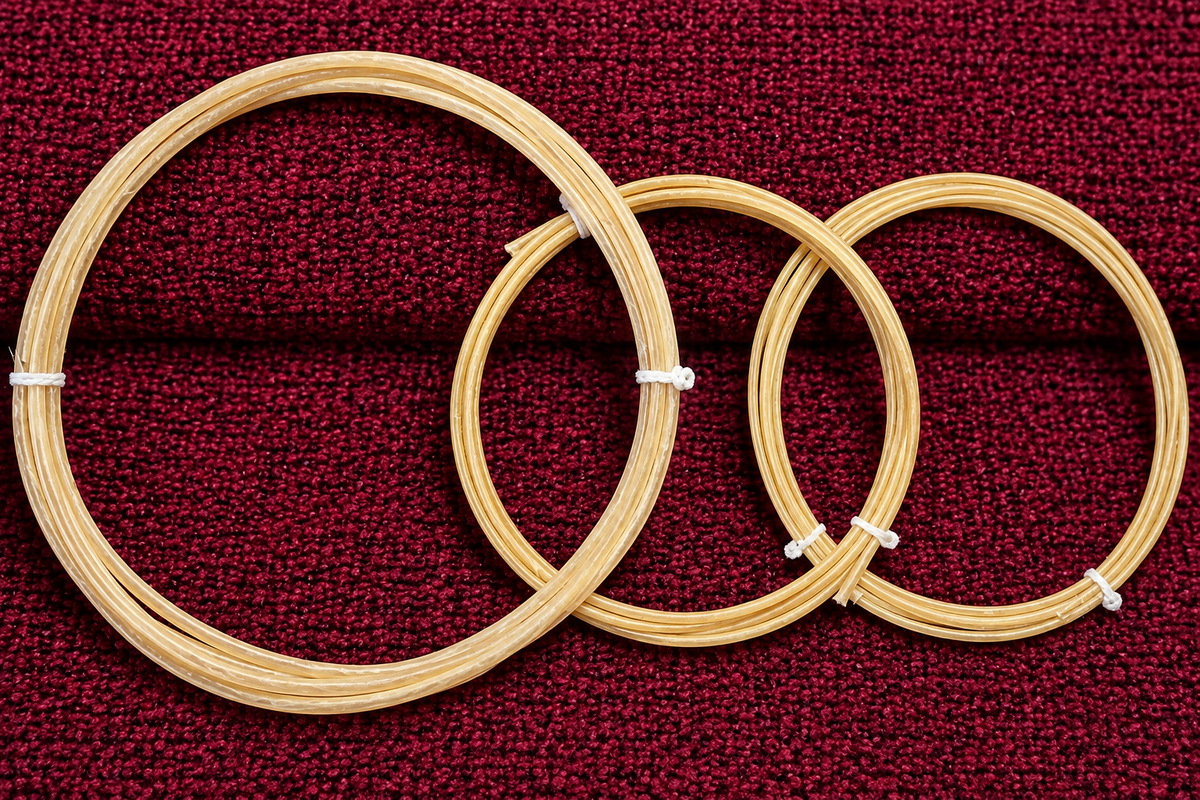
NG String's natural gut bass strings are hand selected and prepared in four diameters — G 2.1mm, D 2.7mm, A 3.4mm, and E 4.2mm (±0.02mm tolerance) — so players and luthiers can fine-tune gauge to the instrument, the string length, and the amount of tension the player prefers. For full bass sets, we offer G-only, DG, ADG, and EADG configurations, with individual strings measuring roughly 65-68 inches (about 200cm) in length to accommodate different bass scale lengths and setup styles. Every string is carefully hand-finished rather than mass-extruded, which is part of why diameter and tension stay consistent from one string to the next within a set — a detail that matters a great deal once a string is under 40+ pounds of tension on an upright bass.
Living With Gut Strings
Gut asks for a little more care than steel, and it rewards that care generously. Because it's an organic material, gut is more sensitive to humidity and temperature swings than steel or synthetic core, so it's worth keeping your instrument in a stable environment and avoiding leaving it in a hot car or a damp basement for extended periods. New gut strings also need a modest break-in period — expect some initial stretching and more frequent tuning during the first few days as the fibers settle in, after which pitch stability improves considerably. Many players find that wiping strings down after playing and storing the instrument in a case between sessions meaningfully extends string life, since gut is more porous than steel and picks up oils and moisture from your hands over time.
Who These Strings Are For
Gut isn't a strings for every player in every context — a touring bassist needing bulletproof pitch stability through six shows a week in variable climates may still prefer steel or a hybrid set. But for jazz and roots musicians chasing that dark, woody thump; for orchestral and chamber players performing period-appropriate repertoire; for teachers and students who want an instrument that's gentler on developing hands; and for anyone simply curious what their bass sounds like without steel in the equation, gut remains genuinely hard to replace.
The NG String Difference
NG String was founded by Kevin Smith, a lifelong player and entrepreneur who built the company around a simple idea: gut strings should be made with the same obsessive attention to consistency and quality control that top players expect from any premium string. Every set is hand-prepared and checked for diameter tolerance before it ships, and the same craftsmanship that's earned NG String a following among string players carries over directly into our musical instrument line. We keep our process small and hands-on because gut doesn't reward shortcuts — and neither do the musicians who depend on it.
Ready to hear the difference for yourself? Browse our full lineup of gauges and sets at ngstring.com, or call us directly at 619-559-2005 and we'll help you find the right set for your bass, your playing style, and your budget.
Frequently Asked Questions
-
Do natural gut strings sound different from steel or synthetic core strings?
Yes, noticeably. Gut produces a warmer, more complex tone with longer sustain and richer overtones than steel, and a rounder, less metallic attack than most synthetic-core strings. It's the sound most closely associated with vintage and pre-war upright bass recordings.
-
Are gut strings harder to maintain than steel strings?
They need a bit more attention. Gut is more sensitive to humidity and temperature, benefits from a short break-in period, and lasts longest when wiped down after playing. In exchange, most players feel the tonal payoff is well worth the extra care.
-
What gauge should I choose for my upright bass?
Gauge depends on your instrument, your string length, and how much tension you prefer under the fingers. NG String offers four diameters — G 2.1mm, D 2.7mm, A 3.4mm, and E 4.2mm (±0.02mm tolerance) — and we're happy to help you match one to your setup — just give us a call at 619-559-2005.
-
Can beginners use gut strings, or are they only for advanced players?
Gut works well for players at any level. Because it's softer on the fingers than steel, many teachers actually recommend it for students who are still building calluses and technique, in addition to its appeal for working professionals.
-
How long will a set of gut strings last?
Lifespan varies with how often you play, your climate, and how well the strings are cared for, but with reasonable maintenance — wiping down after sessions and stable storage — a well-made gut set holds its tone and tension for a solid, comparable stretch to other premium string types.

Written by Javier Lopez